

My Works
Works by OHARA Jigoemon XVI
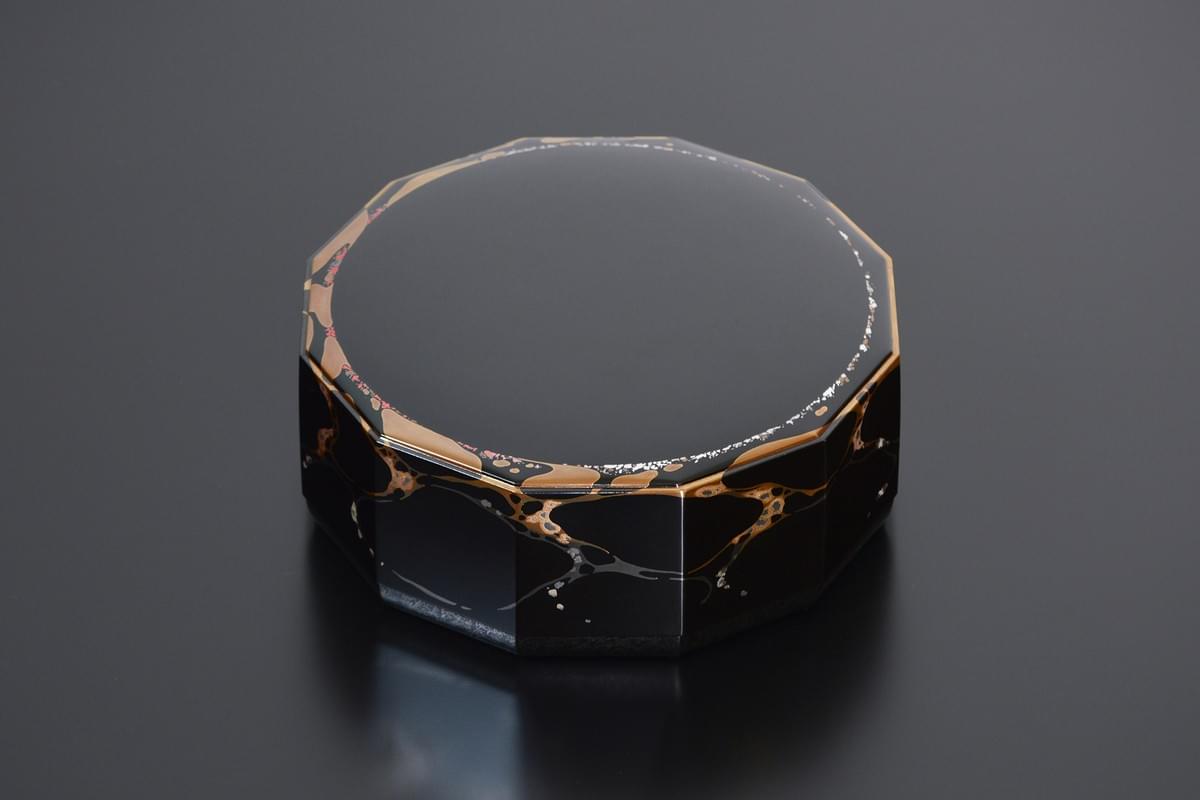
十六代 小原治五右衛門《城端蒔絵飾箱「Eclipse」》
令和6年 (2024)
縦24.2 × 横24.2 × 高9.5 ㎝
第71回 日本伝統工芸展 日本工芸会新人賞
OHARA Jigoemon XVI (b. 1979)
Eclipse, 2024
Coffer; Jōhana Maki-e
h. 3 47/64 x w. 9 17/32 x d. 9 17/32 in (9.5 × 24.2 × 24.2 ㎝)
「Eclipse」と題した今作は、甲面に日食、見込みに月食、側面には光によって映し出される水面を配した。甲面と側面をポジとネガに分けることで、金と銀による陰と陽、黒は白を引き立て、白もまた黒を引き立て、漆黒の深みは委ねることで空となり水にもなる。Eclipseをテーマに、大事なことは変わらずに変わり続ける、城端蒔絵の変容と深化を表現した。
The work titled "Eclipse" features a solar eclipse on its top surface, a lunar eclipse on its base, and light reflection on water on its lateral surface. By dividing the top and the sides into positive and negative, we can see the yin and yang of gold and silver, black and white enhancing each other, and the depth of jet black becomes both sky and water as the viewer is immersed in the imagery. Using the theme of Eclipse, the transformation and deepening of Johana maki-e is depicted, expressing the idea that important things remain the same but also continue to evolve.

十六代 小原治五右衛門《城端蒔絵飾箱「Eclipse Ⅱ」》
令和7年 (2025)
縦25.1 × 横25.1 × 高11.5 ㎝
第64回 日本伝統工芸富山展 日本工芸会賞
OHARA Jigoemon XVI (b. 1979)
Eclipse Ⅱ, 2025
Coffer; Jōhana Maki-e
h. 4 17/32 x w. 9 7/8 x d. 9 7/8 in (11.5 x 25.1 x 25.1 ㎝)
「Eclipse Ⅱ」は、天文現象の「食(しょく)」をテーマに制作したシリーズの第2作目。八角形の箱の蓋には日食を、器の底には月食を描き、対となるふたつの現象をひとつの器に収めた。漆黒に仕上げた甲面は宇宙空間そのものを象徴しており、見る人それぞれが、自らの未来や内なる宇宙を自由に投影して感じていただけるよう願いを込めた。"Eclipse II" is the second piece that I made under the theme of the astronomical phenomenon, "eclipse". I drew the solar eclipse on the lid of the octagonal box and the lunar eclipse at the bottom of the vessel, so that the two different phenomenons could be seen in one box. The top of the box finished in jet black symbolizes outer space itself. I made this piece hoping that those who see this would project their future or the universe within themselves freely onto this piece.
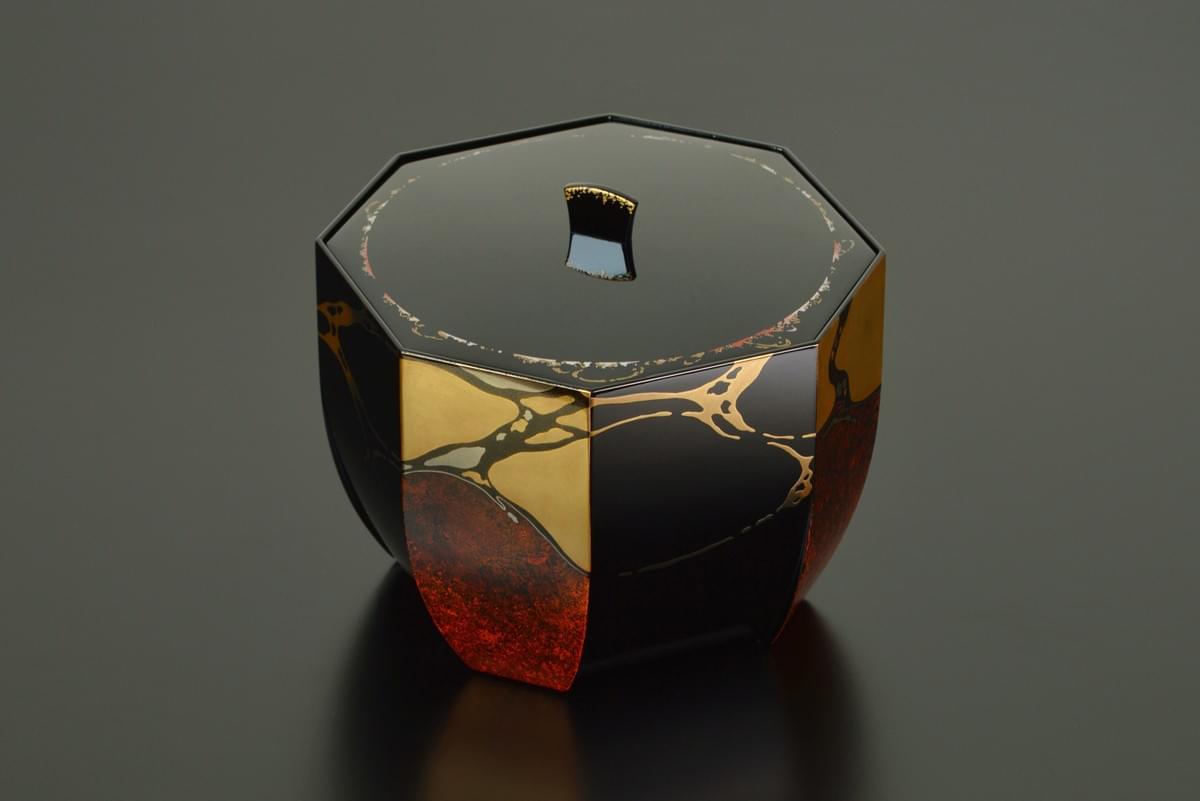
十六代 小原治五右衛門《城端蒔絵蓋物「Prominence」》
令和7年 (2025)
縦20.3 × 横20.3 × 高17.5 ㎝
第72回 日本伝統工芸展
OHARA Jigoemon XVI (b. 1979)
Prominence, 2025
Covered vessel; Jōhana Maki-e
h. 6 57/64 x w. 7 63/64 x d. 7 63/64 in. (17.5 × 20.3 × 20.3 ㎝)
「Prominence」と題した今作は、太陽、月、地球を八角の器物の中に描き、太陽表面から漆黒の宇宙空間に放出されるプロミネンスに城端蒔絵450年の情熱を投影した。
My work entitled “Prominence” depicts the Sun, Moon, and Earth within an octagonal vessel. In it, I project the passion of 450 years of Jōhana maki-e onto the solar prominences erupting from the Sun’s surface into the vast darkness of space.

十六代 小原治五右衛門《治五右衛門塗中次「曙光 - Python VIII」》
令和6年 (2024)
径6.7 × 高6.8 ㎝
第63回 日本伝統工芸富山展 富山県知事賞
個人蔵 / Private Collection ( New York )
OHARA Jigoemon XVI (b. 1979)
Python VIII, 2024
Nakatsugi style urushi tea caddy; Jigoemon-nuri
h. 2 43/64 × dia. 2 41/64 in. (6.8 × 6.7 ㎝)
哲学者・ニーチェの言葉「脱皮できない蛇は滅びる」にインスピレーションを受け、脱皮と深化を和光銀と金蒔絵で表現した。中央の柄を漆の道に見立て、白ではなく漆塗りの起源である朱を用いた。曙光 - Pythonシリーズは、これまでの城端蒔絵とは赴きを異にする新たな作品として紹介され、ニューヨーク、ワシントンD.C.、ジャカルタ、香港などで展示された。
Inspired by a quote from the philosopher Friedrich Nietzsche, “the snake which cannot cast its skin has to die,” the moulting and evolution is illustrated here using palladium and gold maki-e. The central motif is conceived as a path of urushi (Japanese lacquer), rendered not in white but in vermilion―the original colour of urushi. The “Shokō – Python Series” was introduced as a new body of work that departs from conventional Jōhana Maki-e, and has been exhibited in cities such as New York, Washington, D.C., Jakarta, and Hong Kong.
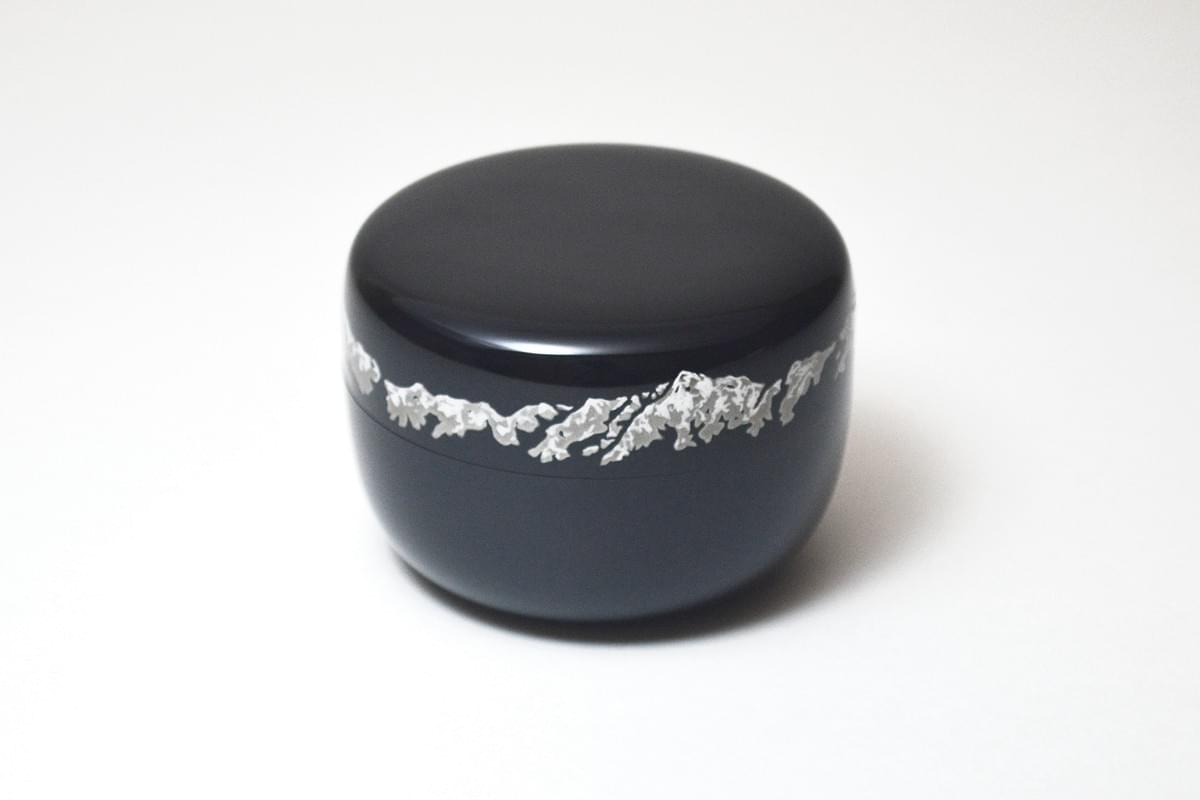
十六代 小原治五右衛門《城端蒔絵平棗「立山連峰」》
令和6年 (2024)
径7.9 × 高5.6 ㎝
第42回 日本伝統漆芸展
個人蔵 / Private Collection ( Japan )
OHARA Jigoemon XVI (b. 1979)
Tateyama Mountain Range, 2024
Hira-Natsume type urushi tea caddy; Jōhana Maki-e
h. 2 13/64 x dia. 3 7/64 in. (5.6 × 7.9 ㎝)
富山県民が日々望む立山連峰を城端蒔絵で表現。内側は雪の結晶をイメージした変り塗の銀地で仕上げた。漆黒の深みは白を引き立て、空となり水となる。
In this work I used Jōhana maki-e to capture contours of the Tateyama Mountain Range, a view admired by the people of Toyama every day. While the layered silver paint finish of the inside portrays the accumulated snow, the depth of the pitch black accentuates the white, representing the sky above and water below.

十六代 小原治五右衛門《城端蒔絵雲錦文飾箱》
令和4年 (2022)
縦14.2 × 横26.1 × 高17.7 ㎝
第69回 日本伝統工芸展
OHARA Jigoemon XVI (b. 1979)
Unkin (Cherry Blossoms and Maple Leaves), 2022
Coffer; Jōhana Maki-e
h. 5 19/32 x w. 10 9/32 x d. 6 31/32 in. (14.2 × 26.1 × 17.7 ㎝)
「雲錦とは、満開の桜を白雲に、色づいた紅葉を錦織に見立てた言葉。城端曳山祭の設え(二曲一双屏風)から箱の形を考案し、甲面の桜から側面の紅葉へのうつろいと水の流れを描き、無常観を表現した。
The term “cloud brocade” is used to describe the pattern formed by stratified red leaves coupled with the cloud-like cherry blossoms. The shape of the box was fashioned after the twin decorative screens used in the Hikiyama Festival of Jōhana. From the lid of the box the cherry blossoms flow towards the red leaves on the sides of the box; this flow coincides with that of water, representing the ever-changing nature of the world.

十六代 小原治五右衛門《城端蒔絵菊花文菓子器》
令和3年 (2021)
縦24.8 × 横24.8 × 高8.4 ㎝
第68回 日本伝統工芸展
OHARA Jigoemon XVI (b. 1979)
Chrysanthemum, 2021
Box for sweets; Jōhana Maki-e
h. 3 5/16 x w. 9 49/64 x d. 9 49/64 in. (8.4 x 24.8 x 24.8 ㎝)
菊花文様は、歴代の治五右衛門がそれぞれの表現と技法で描いてきた意匠である。
祖先を敬い、先祖を偲ぶ心を筆に込めていきたい。
Generations of successors of the Jigoemon name have developed their own expression and techniques in the aesthetics of the chrysanthemum pattern.

十六代 小原治五右衛門《治五右衛門塗飾箱「曙光 - Python VI」》
令和4年 (2022)
縦12.1 × 横10.9 × 高9.0 ㎝
第61回 日本伝統工芸富山展
OHARA Jigoemon XVI (b. 1979)
Python Ⅵ, 2022
Coffer; Jigoemon-nuri
h. 3 35/64 × w. 4 19/64 × d. 4 49/64 in. (9.0 × 10.9 × 12.1 ㎝)
素材をこれまでの和光銀から銀に変え、金蒔絵で描いた脱皮の道の中には銀の岩平目を用いた。時の流れで銀が硫化していくと、銀と金が陰と陽に分かれる。
Switching from the usual paladium to silver, the trail of the moulting painted on with gold maki-e is laid out with iwahirame (“flat-eyed rock”) silver powder. The silver vulcanises as time passes, dividing the silver and gold into yin and yang.
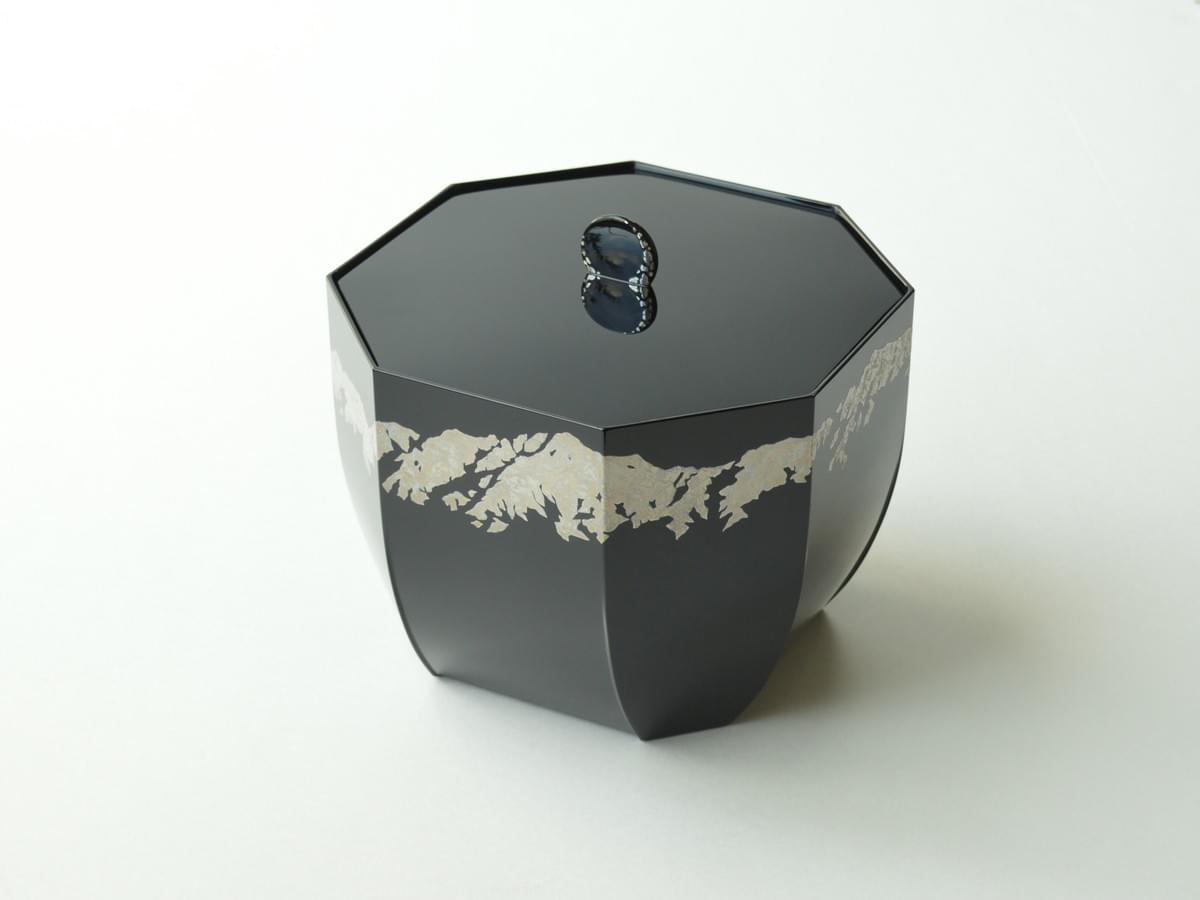
十六代 小原治五右衛門《城端蒔絵水指「立山連峰」》
平成29年 (20017)
縦19.7 × 横19.7 × 高17.1 ㎝
第56回 日本伝統工芸富山展 日本工芸会富山支部賞
個人蔵 / Private Collection
OHARA Jigoemon XVI (b. 1979)
Tateyama Mountain Range, 2017
Mizusashi (Tea ceremony fresh water jar); Jōhana Maki-e
h. 6 47/64 x w. 7 3/4 x d. 7 3/4 in. (17.1 × 19.7 × 19.7 ㎝)
富山県民が日々望む立山連峰を描き、蓋のつまみには日月を、内側は雪の結晶をイメージした変り塗の銀地で仕上げた。
Capturing the view of the Tateyama Mountain Range admired by the people of Toyama every day, the lid depicts both the sun and the moon, while the layered silver paint finish of the inside portrays the accumulated snow.
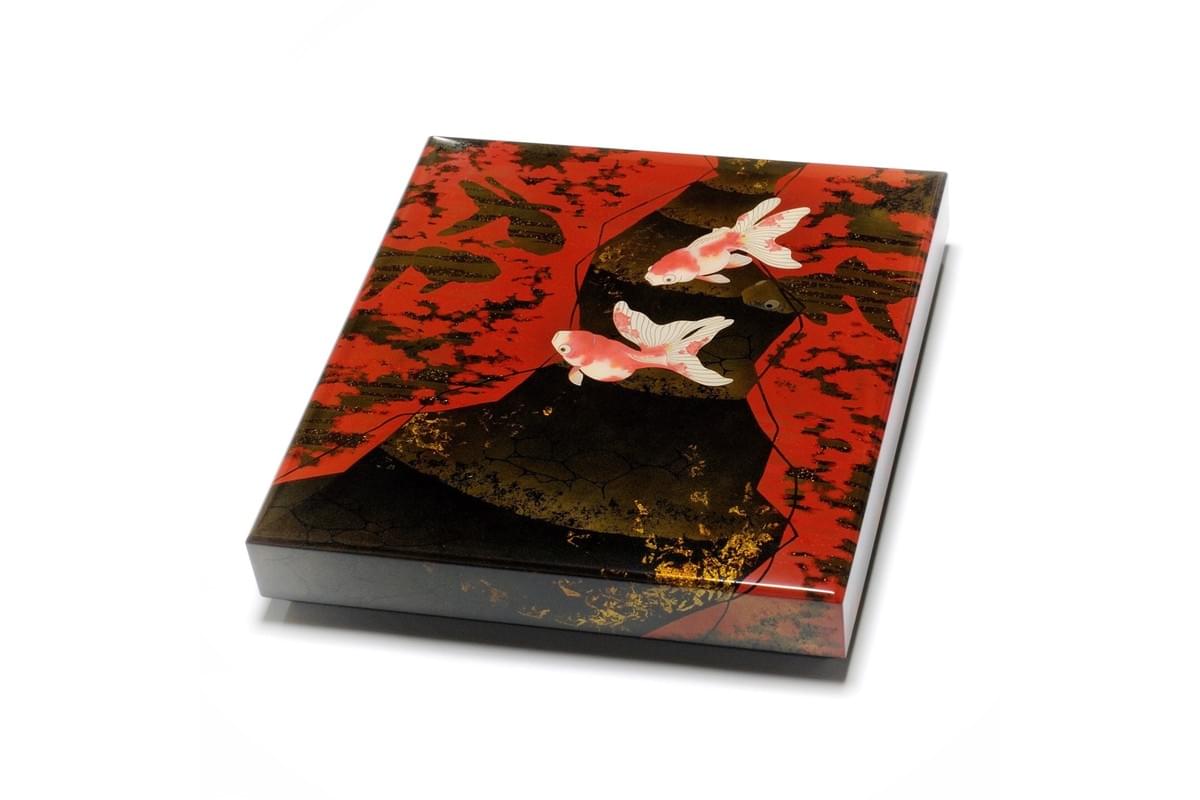
十六代 小原治五右衛門《城端蒔絵色紙箱「游」》
平成21年 (2009)
縦27.4 × 横30.0 × 高5.3 ㎝
第48回 日本伝統工芸富山展
OHARA Jigoemon XVI (b. 1979)
Float, 2009
Shikishi (square paper for writing poem) Box; Jōhana Maki-e
h. 2 3/32 x w. 10 25/32 x d. 11 13/16 in. (5.3 x 27.4 x 30.0 ㎝)
水に映る琉金の朱を水色とし、見る角度によって金魚が浮き出たり水波が現れたり、自由に泳ぐ金魚と波紋を立体的に表現した。
The vermilion of the fantail goldfish is used to represent the water. Depending on the angle it is viewed from, the goldfish could look like they are emerging from the water or making waves as they swim. This piece depicts the goldfish swimming freely and the movement of the water in a three-dimensional perspective.
Ancestral Works
Works by the Ohara Family ( 1st - 15th Generations )

九代 小原治五右衛門《彩漆鯰模様手付盃盆》
天保8年 (1837)
縦15.3 × 横33.3 × 高15.3 ㎝
富山県指定文化財
OHARA Jigoemon Ⅸ (1787 - 1859)
Catfish, 1837
Serving Tray with Handle; Jōhana Maki-e
h. 6 1/32 x w. 13 7/64 x d. 9 9/16 in. (15.3 x 33.3 x 24.3 ㎝)
[ Toyama Prefecture Designated Cultural Property ]九代 治五右衛門は家伝の技法に斬新な感覚で新風を吹き込んだ。天保八年(1837)作「彩漆鯰模様手付盃盆」(富山県指定文化財)は、ちり・むら一つとどめぬ豪快な塗り立ての上に、二匹の鯰を大胆な構図で描き、白い腹が鮮やかに浮かび上がる生命感あふれる作品である。これは小原家一子相伝の白蒔絵の特色を表す代表作の一つで、世上に「治五右衛門の白鯰」と賞賛され、各皇族も御覧になった由緒ある作品である。
Jigoemon Ⅸ introduced a fresh and innovative sensibility to the hereditary techniques of the family. In 1837, he produced “Polychrome Lacquer Sake Tray with Handle, Decorated with Catfish” (designated as a cultural property of Toyama Prefecture). Executed on a boldly applied lacquer surface of flawless finish, free from any trace of dust or unevenness, the work depicts two catfish in a dynamic composition, their white bellies vividly emerging with a striking sense of vitality. This piece is one of the representative works embodying the distinctive character of the Ohara family’s white maki-e, a technique passed down from father to son through generations. Widely praised as “Jigoemon’s White Catfish,” it is a work of distinguished provenance that has been viewed by members of the Imperial Family.

八代 小原治五右衛門《鶏に花篭蒔絵硯箱》
江戸時代後期
縦24.8 × 横23.2 × 高4.0 ㎝
南砺市指定文化財
OHARA Jigoemon Ⅷ (1764 - 1813)
Rooster and Hen with Flower baskets, Late Edo period (18th - 19th century)
Writing Box (Suzuribako); Jōhana Maki-e
h. 1 37/64 x w. 9 9/64 x d. 9 49/64 in. (4.0 x 23.2 x 24.8 ㎝)
[ Nanto City Designated Cultural Property ]七代 治五右衛門の後は、その子の八代・治五右衛門、九代・治五右衛門に受け継がれていくが、この頃は城端蒔絵の最隆盛期であって、それぞれの精進努力と旺盛な研究により、白蒔絵の技術はさらに進歩し、蒔絵の題材も多様化して巧みな意匠構成をした。八代 治五右衛門の代表作「鶏に花籠蒔絵硯箱」(南砺市指定文化財)は、絞漆を用いた銭目塗という特異な塗りの上に、鶏と菊を精巧華麗に表現している。
After Jigoemon Ⅶ, the lineage was carried on by his successors, Jigoemon Ⅷ and Jigoemon Ⅸ. This period marked the height of prosperity for Jōhana Maki-e. Through their dedicated efforts and vigorous pursuit of innovation, the techniques of white maki-e were further refined, while the range of subjects expanded, resulting in increasingly sophisticated and well-composed designs.
A representative work by Jigoemon Ⅷ, “Maki-e Inkstone Box with Rooster, Hen, and Flower Basket” (Nanto City Designated Cultural Property), features an unusual lacquering technique known as Zenmoku-nuri, created using shibori-urushi. Upon this distinctive surface, a rooster and chrysanthemums are rendered with remarkable precision and elegance.

八代 小原治五右衛門《渾天儀》
文化9年 (1812)
径45.8 × 高52.0 ㎝
南砺市指定文化財
OHARA Jigoemon Ⅷ (1764 - 1813)
Armillary sphere, 1812
h. 20 15/32 × dia. 18 1/32 in. (52.0 × 45.8 ㎝)
[ Nanto City Designated Cultural Property ]
渾天儀は紀元前二世紀頃、中国やギリシヤにおいて用いられて以来、望遠鏡による天体観測が進むまで盛んに用いられた星座の移動、天体の運行等に関する観測機器である。この渾天儀は八代 治五右衛門(一白)が、文化九年(1812)に、親戚でもある天文学者・西村太冲の指導を得て作成したものと推定される。一白の多芸多才な一面を伺い知らされるものであり、台や環には蘭語を装飾的に配し、「亜細亜人一白作」と銘が入っているところに、一白の自信のほどがうかがえる。
The Kontengi (Armillary sphere) was first used in China and Greece in the 2nd century B.C., and was widely used to model celestial bodies until the development of telescope-based astronomical observations. It is estimated that this particular armillary sphere was made in 1812 by Jigoemon Ⅷ (Ippaku) under the guidance of the astronomer Taichu Nishimura, to whom he was related. Its existence is one of many monuments illustrative of his multi-faceted talents. The ornately decorated base and ring are engraved with Dutch words, and the inscription, "Made by Ippaku, an Asian,” a sign of Jigoemon Ⅷ's confidence in his work.
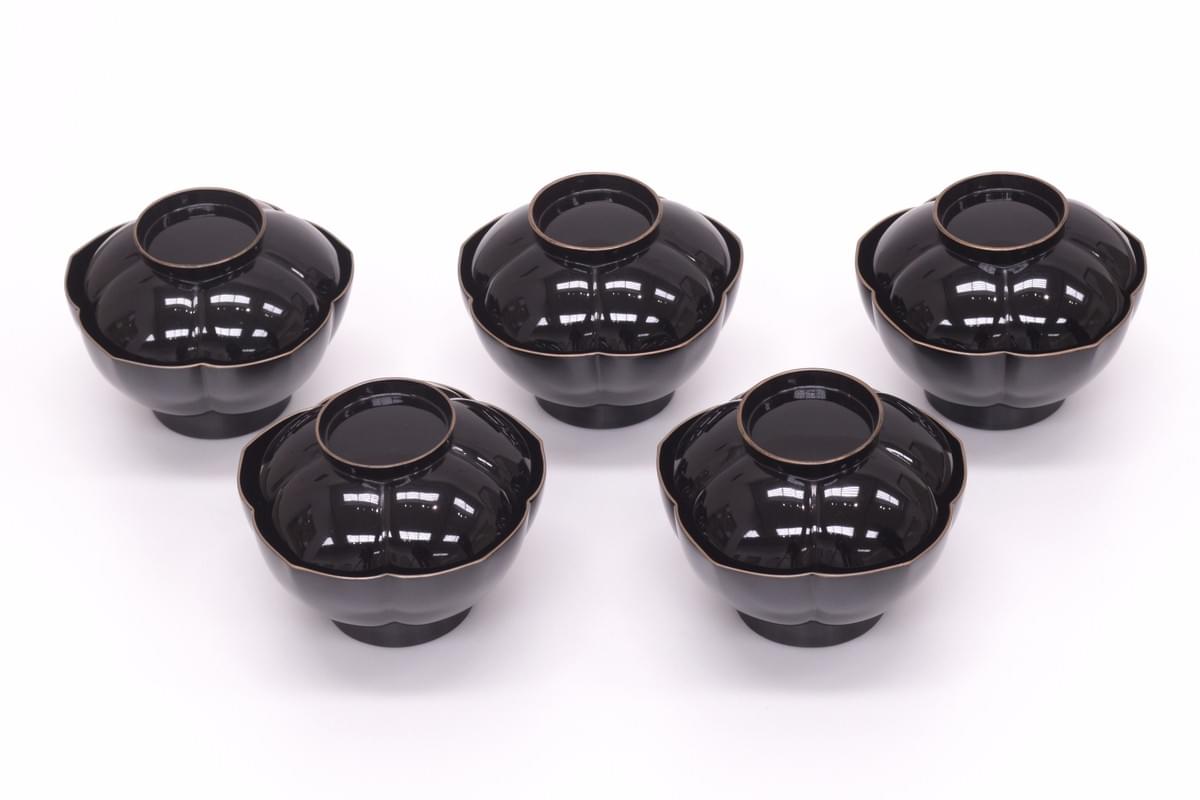
七代 小原治五右衛門《桔梗形乾漆吸物椀》
江戸時代中期
縦11.0 × 横11.0 × 高8.8 ㎝
南砺市指定文化財
OHARA Jigoemon Ⅶ (1729 - 1805)
Chinese bellflower, Mid-Edo period (18th century)
Set of Soup bowls; Kanshitsu
h. 3 15/32 x w. 4 21/64 x d. 4 21/64 in. (9.0 x 11.0 x 11.0 ㎝)
[ Nanto City Designated Cultural Property ]七代 治五右衛門は、城端蒔絵「中興の祖」と仰がれ、多くの門弟を育て城端塗の最盛期を築き、曳山・庵屋台をはじめ多くの作品を残した。乾漆技法による蒔絵を施さない「桔梗形乾漆吸物椀」十客(南砺市指定文化財)は、城端塗の代表作の一つである。謡曲や囲碁にも巧者であり、余技として雛人形も制作し、和歌・俳諧にも長じ文藻に富んだ。安永の曳山騒動では、身を挺して尽力した豪気な一面は多くの人に感動を与えた。
Jigoemon VII is revered as the patriarch of the restoration of Jōhana Maki-e. He trained numerous disciples, ushered in the golden age of Jōhana Lacquering, and produced a wide range of works, including the Hikiyama festival floats and portable shrine pavilions. Among his representative works is the ten-piece set titled “Balloon Flower Dry Lacquer Soup Bowls” (designated as a cultural property of Nanto City), executed using the kanshitsu technique without the application of maki-e. These works stand as exemplary masterpieces of Jōhana Lacquering. A man of broad cultural refinement, he was skilled in Noh chanting and the game of igo, and also created hina dolls as a personal pursuit. He excelled in waka and haikai poetry, demonstrating a rich literary sensibility. During the Hikiyama dispute of the An’ei era, he devoted himself selflessly to the community, and his courageous spirit left a deep impression on many.
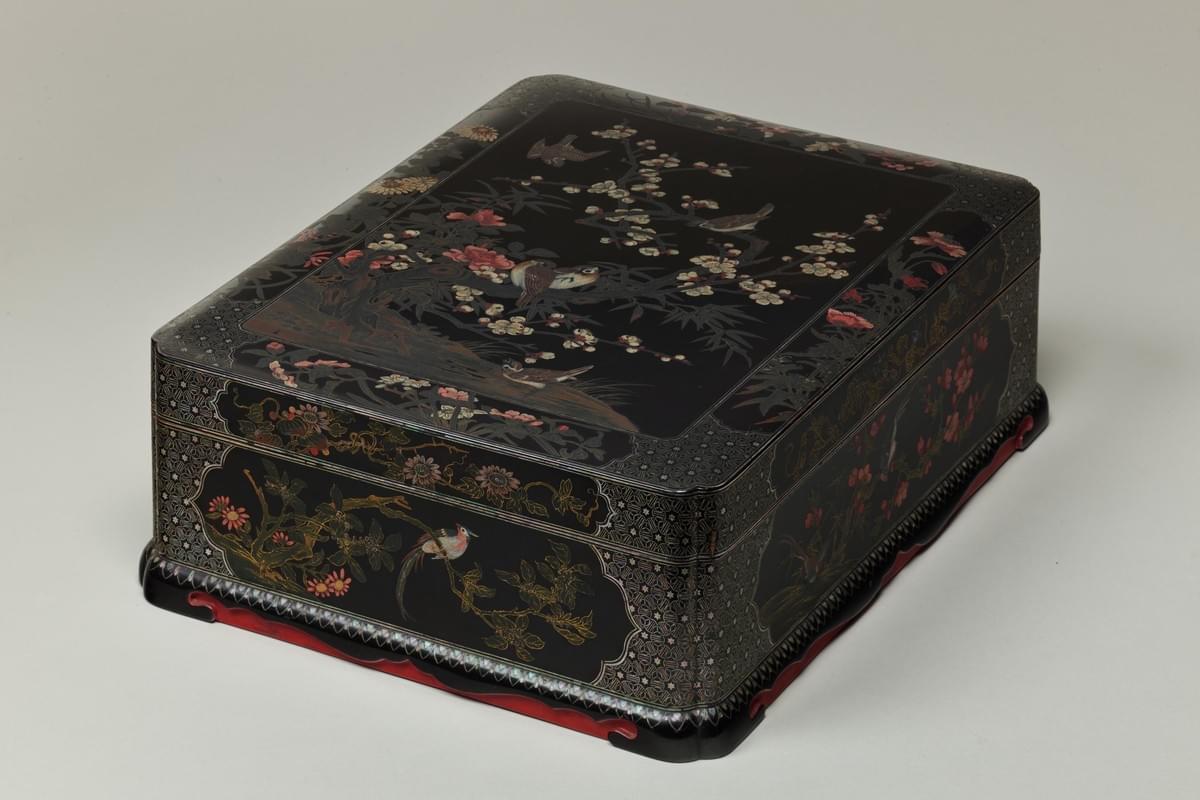
十一代 小原治五右衛門《花鳥密陀絵料紙箱》
明治時代
縦42.6 × 横33.0 × 高14.0 ㎝
東京国立博物館蔵
OHARA Jigoemon Ⅺ (1835 - 1879)
Birds and Flowers, Meiji era (19th century), Box for Papers; Mitsuda-e
h. 5 33/64 x w. 12 63/64 x d. 16 49/64 in. (14.0 x 33.0 x 42.6 ㎝)
[ Tokyo National Museum collection ]廃藩置県によって、従来、大名や富豪の庇護を受けていた世の漆工家たちはその職を失い、古い伝統を誇った各系統や各流派が崩壊消滅していった。城端では幕末から明治にかけて、十代、十一代、十二代 治五右衛門が出て、城端蒔絵の伝統を守った。十一代 治五右衛門は一層精巧緻密な作品を残した。慶応元年(1865)作、「花鳥文九ツ組乾漆盃」は、絵画的にも優れ、優雅で美しい。「花鳥文料紙箱」(東京国立博物館蔵)は、密陀絵と螺鈿を交えて、精細な技術で華麗な表現を行っている。
During the Abolition of the Han System, many lacquer artists who had long depended on the patronage of feudal lords and wealthy families lost their livelihoods, and numerous lineages and schools with proud and longstanding traditions fell into decline or disappeared altogether. In Jōhana, however, from the final years of the shogunate into the Meiji period, the lineage endured without interruption, as Jigoemon Ⅹ, Jigoemon Ⅺ, and Jigoemon Ⅻ succeeded one another, steadfastly preserving the tradition of Jōhana maki-e. Among them, Jigoemon Ⅺ is especially renowned for works of heightened precision and refinement. His Set of Nine Dry-Lacquer Sake Cups with Flower-and-Bird Motifs (1865) is notable for its painterly excellence, embodying both elegance and a graceful sense of beauty. The Flowers-and-Birds Writing Box (collection of the Tokyo National Museum) combines mitsuda-e and mother-of-pearl inlay, achieving a richly ornate expression through exceptionally fine and meticulous craftsmanship, and exemplifying a high level of technical sophistication.


